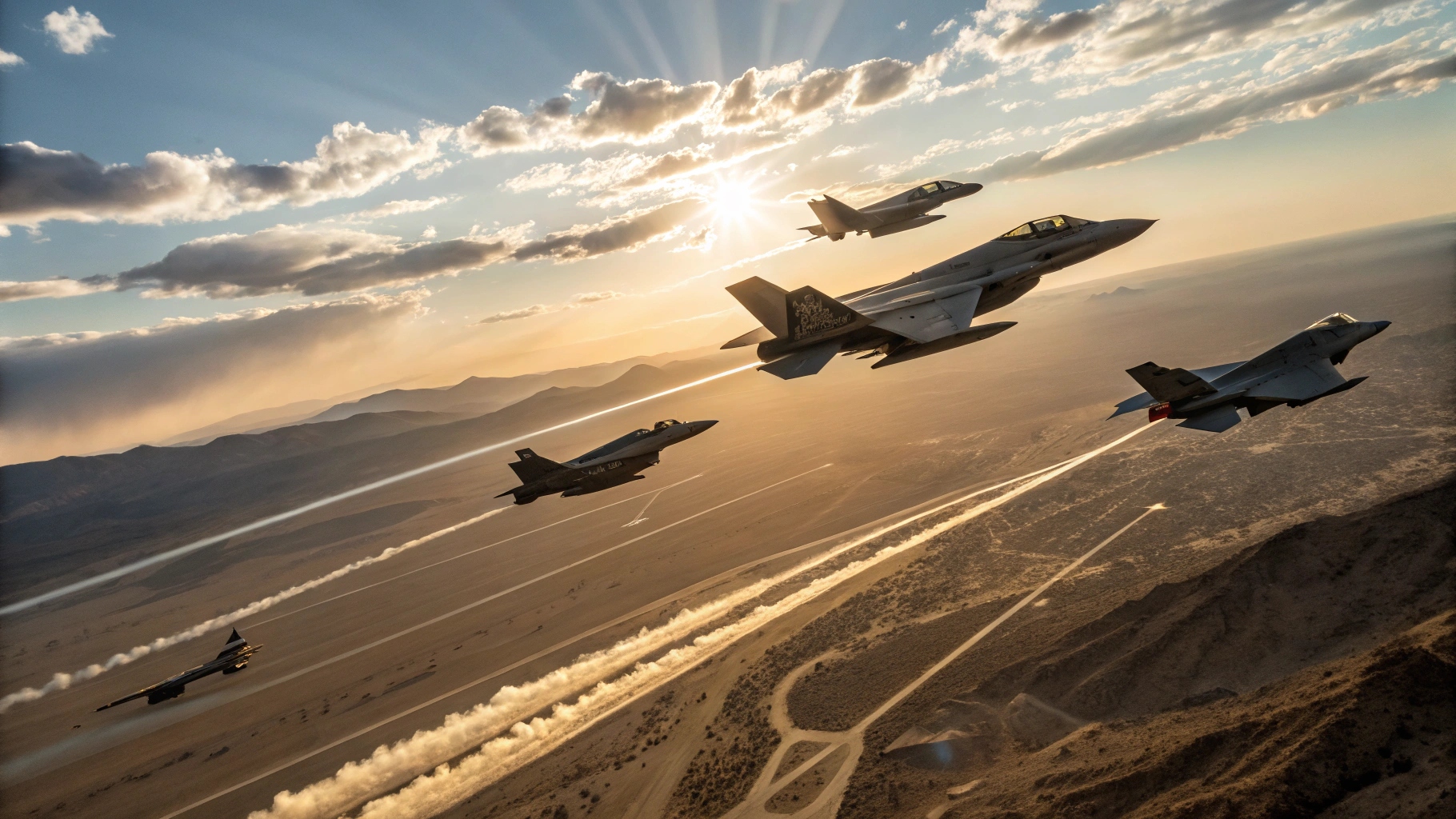

Satellite imagery indicates that China has assembled nearly 300 aircraft across 11 western desert airbases for what could be one of its largest air force exercises in recent years. The Mitchell Institute for Aerospace Studies assesses that the activity is likely connected to Red Sword 2026, with participation potentially exceeding 300 aircraft when platforms inside shelters are included. The deployment features J-20 stealth fighters, J-16 and J-10 fighters, H-6 bombers, Y-20 transports, aerial refuelling tankers, and specialised support aircraft. The buildup reportedly began in mid-October, with transport aircraft and tankers arriving around October 17–18 before fighters, bombers, and other support platforms followed. Imagery reviewed by the institute showed almost 300 aircraft parked on airfield ramps, compared with the usual 80 to 100 across the same locations. Although not every aircraft may be directly involved, the concentration represents a significant mobilisation and has been assessed as one of the largest Red Sword deployments in several years. The exercise is intended to test the People’s Liberation Army Air Force’s ability to operate as an integrated combat force, coordinating stealth and conventional fighters with bombers, tankers, and support platforms across a wide area. The presence of transports, refuelling aircraft, and specialised mission systems also demonstrates that China’s air force modernisation extends beyond frontline fighters to operational reach, endurance, and force projection. Dispersing aircraft away from permanent bases requires extensive logistical preparation, including fuel, spare parts, maintenance personnel, and support equipment. Red Sword therefore offers an opportunity to practise sustaining air operations from multiple locations over extended periods. Tanker deployments are particularly relevant to extending aircraft endurance and improving mission flexibility, although satellite imagery cannot reveal the specific refuelling missions being conducted. Previous suspected Red Sword exercises reportedly involved operations lasting several weeks across hundreds of nautical miles before units consolidated at Dingxin Air Base. If this year’s exercise follows a similar pattern, participating forces could gain experience operating from unfamiliar bases while maintaining sustained activity. Nevertheless, satellite imagery cannot establish sortie rates, mission success, or actual combat effectiveness. The wider significance for the United States and its allies is China’s growing focus on integrating large numbers of aircraft into a coordinated air campaign. In a potential Indo-Pacific contingency, sustained operations could challenge allied airfields, communications, fuel infrastructure, maintenance systems, and supporting aircraft. The deployment also highlights the relevance of the US Air Force’s Agile Combat Employment concept, which seeks to reduce vulnerability by distributing aircraft across multiple operating locations. However, dispersed operations also demand reliable protection, communications, supply chains, and maintenance at every location. The exercise does not demonstrate that China could achieve comparable performance in wartime, particularly under electronic warfare conditions, over contested maritime areas, or while sustaining combat losses. Nor does the available assessment confirm naval participation or establish a specific Taiwan-related scenario. Instead, its significance lies in the scale of China’s rehearsal of air force integration, logistical coordination, and the ability to sustain a major air campaign.