

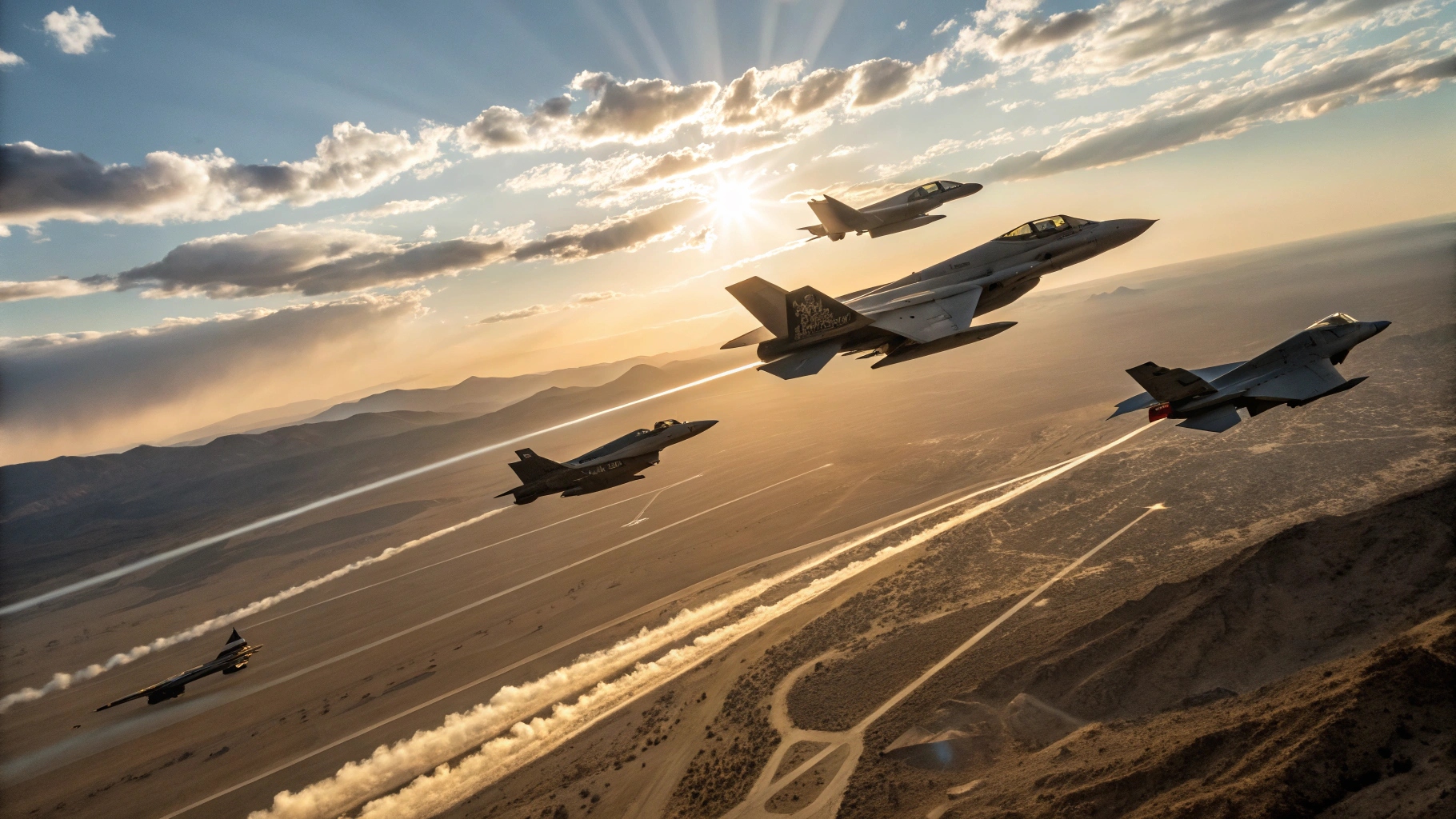
Russia is reportedly offering India more than the Su-57 fighter itself. The proposed package is said to combine the aircraft with a selection of advanced missiles and unmanned systems designed to exploit its stealth characteristics and internal weapon-storage capacity.
The Su-57’s internal bays are a major part of this approach. Unlike aircraft that depend heavily on external weapon pylons, the Russian fighter can carry selected munitions internally, helping maintain a lower radar signature. This has encouraged the development of smaller weapons specifically suited to the aircraft.
One of the main systems reportedly associated with the offer is the Kh-69 cruise missile. Designed for land attack and suppression of enemy air defenses, the missile uses folding wings to support internal carriage. Its reported export range is around 290 kilometers, with guidance combining inertial navigation, electro-optical sensing and imaging infrared technology.
The R-77M provides an air-to-air capability for beyond-visual-range engagements. The missile is designed for internal carriage and is reportedly equipped with an AESA radar seeker and dual-pulse motor. Its estimated range is between 160 and 200 kilometers, giving the Su-57 an enhanced long-range air-combat option.
The R-37M provides a different capability by focusing on distant and high-value airborne targets. It is reported to have a range of up to 400 kilometers and speeds approaching Mach 6. The weapon can threaten platforms such as airborne early-warning aircraft, tankers and intelligence-gathering aircraft, and Russia is reportedly integrating it with the Su-57’s advanced electronic system.
A proposed miniaturised Kinzhal could add a long-range hypersonic strike option. Because the standard Kh-47M2 Kinzhal cannot fit inside the Su-57, the reported smaller version is intended to overcome that limitation. Although public information is limited, the concept is linked to speeds near Mach 10 and a possible range of 2,000 kilometers.
The S-71K is another reported component. This low-observable strike system is described as a hybrid between a cruise missile and an unmanned aircraft. It reportedly carries a 250-kilogram warhead, can travel roughly 300 kilometers and supports either autonomous operation or control by the pilot.
The unmanned side of the package is represented by the S-70 Okhotnik-B. The stealth combat drone is intended to work with manned fighters in reconnaissance, electronic warfare and strike missions. A proposed two-seat Su-57 configuration could potentially control several drones at the same time.
Taken together, the proposal shows an effort to build a networked combat architecture around the Su-57. The fighter would act as a central platform supported by air-to-air missiles, cruise missiles, hypersonic systems and unmanned aircraft.


