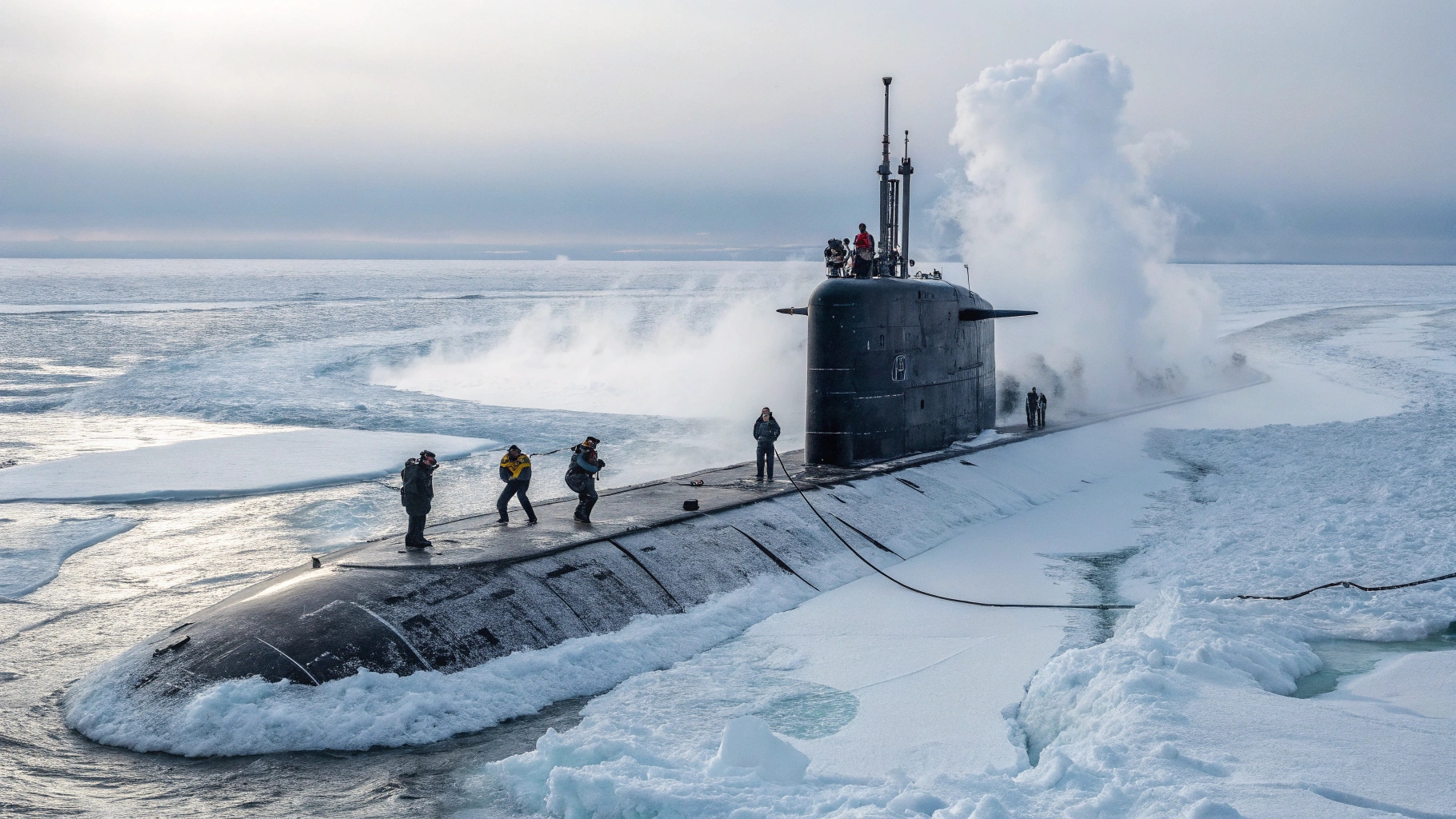

Fresh commercial satellite imagery has revealed one of the clearest views yet of a new Chinese nuclear-powered attack submarine being constructed at the Bohai Shipyard in Huludao. The vessel is widely assessed as a possible Type-095, although China has not officially confirmed its identity. Images collected by Vantor on September 18 show the submarine in the construction stage at a strategically important centre of China’s nuclear-submarine industry. Naval analysts have focused on the stern because it appears to display pump-jet propulsion and an X-shaped tail-control system. Unlike an exposed conventional propeller, a pump-jet places the propulsor inside a shroud, a configuration commonly associated with reduced acoustic output, better efficiency at higher submerged speeds and greater survivability. Lower noise is particularly valuable for attack submarines because it can complicate detection by enemy submarines, surface vessels and maritime patrol aircraft. The apparent X-tail is another departure from the cruciform arrangement seen on many earlier Chinese nuclear submarines. It can provide improved underwater control and manoeuvrability and may help lower acoustic and hydrodynamic signatures. Other unusual hull structures have prompted discussion about possible additional payload capacity, while some analysts have suggested the design could eventually accommodate advanced missile-launch systems. These possibilities remain unconfirmed. Openings observed toward the forward part of the hull could potentially be linked to sonar or other specialized equipment, but their exact function is not known. The suspected Type-095 is expected to replace the Type-093 family and could represent a significant advance in Chinese nuclear attack-submarine technology. At the regional level, Pakistan is expanding its underwater force through eight Hangor-class submarines derived from China’s Type-39A design. Four are being constructed in China and four in Karachi, with the overall program expected to conclude by 2028. The vessels use AIP technology to increase submerged endurance. Pakistan is expected to have 11 submarines once all eight new boats are delivered, with nine projected to possess AIP. India operates 16 attack submarines and three strategic nuclear submarines, while its conventional force includes Kalvari, Sindhughosh and Shishumar classes. The Indian Navy is pursuing a DRDO-developed AIP system for Kalvari-class boats and is also progressing with P-75I, Project-76 and Project-77. P-75I, valued at about ₹70,000 crore, seeks six to nine advanced conventional submarines, while Mazagon Dock Shipbuilders and ThyssenKrupp Marine Systems have cleared technical evaluations. India is additionally pursuing another leased Russian nuclear-powered submarine. The developments collectively illustrate the accelerating focus on stealth, underwater endurance and advanced propulsion across Asian submarine fleets.